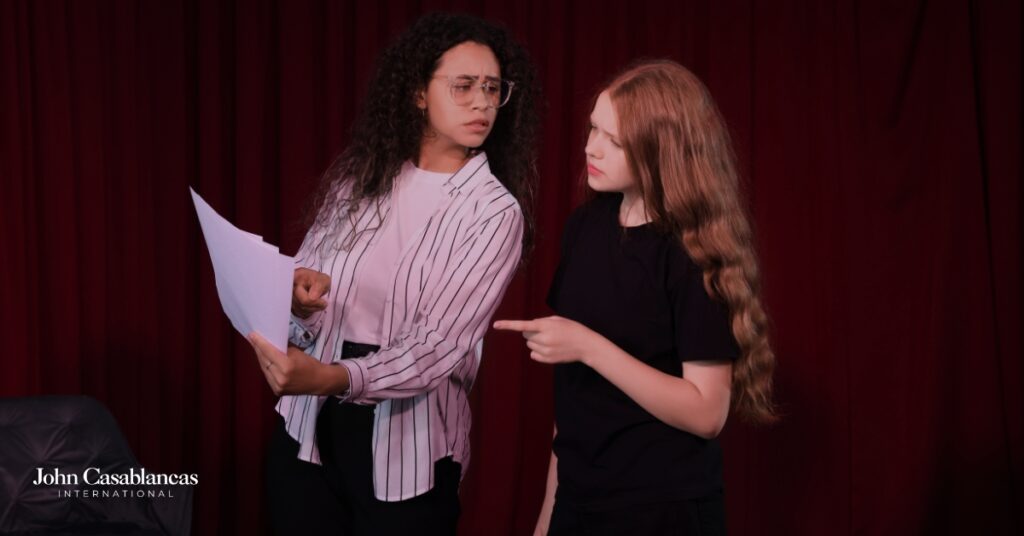
Acting classes offer something that no amount of solo practice, YouTube tutorials, or film study can replicate. Many aspiring performers assume that talent is the deciding factor in a career, and that training is simply a way to sharpen what you already have. In reality, acting classes develop specific skills that self-study cannot produce at all. Understanding what those skills are helps any aspiring actor see why structured training is not optional but foundational.
How to Take Direction in Acting Classes
One of the most underestimated skills in professional acting is the ability to receive direction and apply it immediately. On a film set or in a theater rehearsal, a director gives adjustments in real time. The expectation is that the performer integrates the note and delivers something different in the next take or moment.
Acting classes create the only reliable environment for practicing this. A teacher gives a note during a scene, and the student must absorb it and shift their performance on the spot. This is a genuinely distinct skill from simply performing well on your own. When you rehearse alone, every choice is one you have already anticipated. Responding to directions you did not expect is a completely different challenge, and it requires training with another person in the room to develop.
What Acting Classes Build That Self-Study Cannot
Most self-taught performers spend the majority of their practice time on their own lines, delivery, and facial expressions. This is understandable, but it misses where much of professional acting actually lives. The reaction, not the line delivery, is frequently what a casting director or director remembers.
Authentic listening in acting depends on genuine unpredictability. When a scene partner does something unexpected, the only truthful response is a real one. Acting classes create this condition naturally. Scene work in a class involves other people making choices you did not plan for, which forces you to respond in the moment rather than execute a rehearsed version of the scene.
Acting at a trained level requires real vulnerability and willingness to be fully present with another performer. You cannot manufacture that condition alone in front of a mirror. Over time, the habit of listening rather than simply waiting for your cue becomes instinctive, and it is that quality that makes a performance feel alive rather than rehearsed.
Cold Reading and Audition Technique
Cold reading is the ability to perform unfamiliar material convincingly on short notice. Auditions frequently involve sides handed to a performer minutes before the read-through begins. The ability to find the character, identify the emotional arc, and deliver the material without preparation time is a skill entirely distinct from performing well-rehearsed work.
Acting classes drill cold reading consistently, building the mental muscle needed to pick up new material and make immediate, confident choices. This is one area where structured training provides something irreplaceable. The more times you have cold-read in a class setting, the faster your instincts become when the clock is ticking in a real audition.
Beyond the material itself, audition technique covers procedural skills that rarely come up in self-study. How to enter the room, how to slate, how to take direction during the read itself, and how to exit professionally all influence the impression a performer leaves. Casting directors notice the full picture, and these behaviors are learned rather than intuitive.
Physical Awareness and Stage Presence in Acting Classes
Self-study tends to concentrate on the voice and the face. Trained performers understand the entire body as an expressive instrument. Acting classes teach physicality directly, such as how posture communicates status, how movement patterns reveal character, and how stillness can carry as much weight as action.
Stage presence is not something most people arrive with naturally. Body and movement work, including awareness of how limbs move and what space they occupy, is an essential component of serious actor training. That awareness is developed by performing in front of other people, receiving feedback, and repeating the process.
Even performing for a small class creates a qualitatively different experience from practicing alone. The awareness that another person is watching changes the way the body responds, and learning to stay present and intentional under that condition is exactly what repeated class work builds.
Objective Feedback You Cannot Give Yourself
One of the fundamental limits of self-study is that you cannot observe yourself from the outside while you are performing. Recording yourself and reviewing the footage comes close, but it misses the immediate, in-context feedback that a trained instructor provides in real time.
Acting classes offer that outside perspective consistently. Instructors identify patterns and habits that the performer cannot see from the inside. Common issues, such as indicating emotion rather than genuinely feeling it, or pulling back in moments that require full commitment, are difficult to catch on your own because they feel natural from inside the performance. Over time, regular feedback from an instructor develops the kind of self-awareness that no amount of self-tape review can replicate on its own.
Building the Confidence to Fail in Public
Fear of judgment is one of the most common barriers between aspiring performers and authentic performance. Acting classes address this directly by creating a structured environment where trying something that does not work is expected and even encouraged.
At John Casablancas International, the acting program is built around the skills covered in this post. Students work on scene study, audition technique, cold reading, and on-camera performance in a structured, supportive environment designed for beginners and developing performers alike.
When you are ready to take your first step, book your audition with John Casablancas International and find out what structured training can do for you.

Rebecca Lord is the Chief Marketing Officer at John Casablancas Modeling and Career Centers, where she leads strategic marketing to grow brand visibility. With over a decade in copywriting, social media, and ROI-driven campaigns – plus 14 years as a freelance copywriter and designer – she specializes in messaging that resonates and delivers results. She’s based in Greater St. Louis.