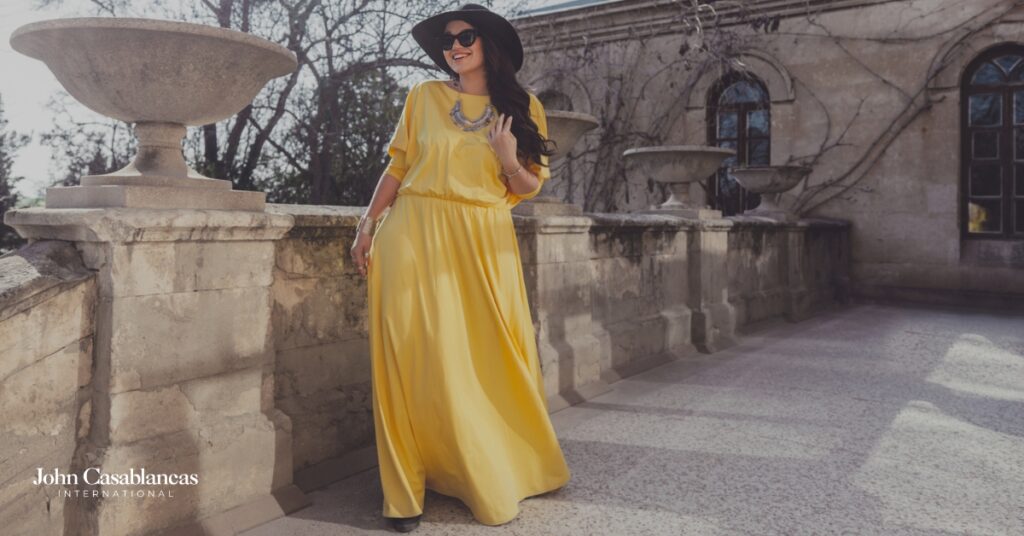
For decades, the fashion industry operated under a rigid, monolithic aesthetic. The sample size was traditionally a US 0 or 2, and it was the undisputed sun around which all design, marketing, and retail orbited.
However, a seismic shift has reached its tipping point. Curve models are no longer the alternative or inclusive outliers of the industry. They have become its economic and structural backbone. This transformation is a sophisticated evolution driven by data, technology, and the undeniable power of consumer demand.
The Economic Engine
The primary driver of the curve model revolution is, unsurprisingly, financial. The global plus-size clothing market has reached an estimated valuation of $260 billion. What was once dismissed as a niche segment is now growing at a rate that significantly outpaces the general apparel sector.
Retailers have realized that ignoring the average consumer, who in many Western markets wears a size 14 or higher, is a massive fiduciary failure. In this landscape, curve models serve as the faces of core volume marketing.
Unlike the tokenism of the early 2010s, where a single non-straight-size model might appear in a campaign for optics, today’s major brands build entire product lines around curve talent. Modeling agencies have responded to this demand by expanding their curve departments.
In major fashion capitals like Paris and Milan, the number of active professional curve models has increased. This surge has led to a landmark moment in the industry of pay parity.
Solving the Fit Crisis
Beyond the billboards, curve models are fundamentally changing how clothing is engineered. Historically, the industry used linear grading, which involved taking a small pattern and simply expanding its dimensions.
This approach failed because bodies do not grow linearly, and proportions change. This technical gap resulted in astronomical return rates in e-commerce, often exceeding 30%, as consumers struggled with ill-fitting garments.
Enter the Digital Twin era. Now, curve models are integral to the research and development phase. Brands use 3D body scanning of curve models to create high-fidelity digital avatars.
These twins allow designers to simulate how different fabrics, from rigid denim to fluid silks, drape over a 2XL frame before a single physical prototype is ever sewn. By using curve models as technical fit-testers, brands have significantly reduced size complexity issues, leading to higher consumer satisfaction and a dramatic drop in waste and shipping returns.
Luxury vs. High-Street
While the mid-market has embraced the curve revolution with open arms, the luxury sector presents a more complex narrative. In 2026, we see a distinct decoupling of trends. Brands like Nike, Target, and Decathlon have fully normalized curve casting, with over 60% of their advertising featuring non-traditional bodies. For these brands, the goal is utility and lifestyle alignment.
In contrast, the high-fashion runways have shown a surprising resistance. Data from the most recent Fashion Weeks suggests a luxury shrink, where only 0.9% of models were plus-size. Some elite houses have returned to a preference for extremely thin frames, often using manufactured curves through corsetry and structural padding rather than casting actual curve talent.
This creates a fascinating tension, because as the general public demands more realism, the ivory tower of luxury is doubling down on exclusivity and attainability as its primary brand currency.
The Aspirational Shift of Wellness and Streetwear
The role of the curve model has also evolved in terms of lifestyle credibility. For decades, plus-size models were relegated to specific categories of lingerie, bridal, or lifestyle shoots that emphasized comfort over cool. In more recent times, this glass ceiling has shattered.
Curve models are now the primary faces of high-performance activewear and edgy streetwear. Casting directors today look for models who represent lifestyle authenticity. A curve model is now there to represent a specific demographic, the 26-to-40-year-old consumer who is financially independent, health-conscious, and fashion-forward.
This shift has forced the industry to move away from clichés. We are seeing curve models in high-intent digital spaces, such as AI-driven shopping assistants, where their data-backed fit profiles help users find the perfect look in real-time.
Leading the Next Era With John Casablancas International
The fashion landscape has fundamentally transformed, moving from a singular ideal to a data-driven, inclusive standard where curve models are the architects of the industry’s future. As brands prioritize technical precision and authentic lifestyle representation, the demand for professional, high-caliber talent has never been greater.
John Casablancas International stands at the forefront of this movement, scouting and developing the diverse faces that bridge the gap between high-fashion aspiration and real-world commercial success. By championing the next generation of curve talent, John Casablancas International ensures that the industry’s evolution isn’t just a trend, but a lasting standard of excellence.

Rebecca Lord is the Chief Marketing Officer at John Casablancas Modeling and Career Centers, where she leads strategic marketing to grow brand visibility. With over a decade in copywriting, social media, and ROI-driven campaigns – plus 14 years as a freelance copywriter and designer – she specializes in messaging that resonates and delivers results. She’s based in Greater St. Louis.